
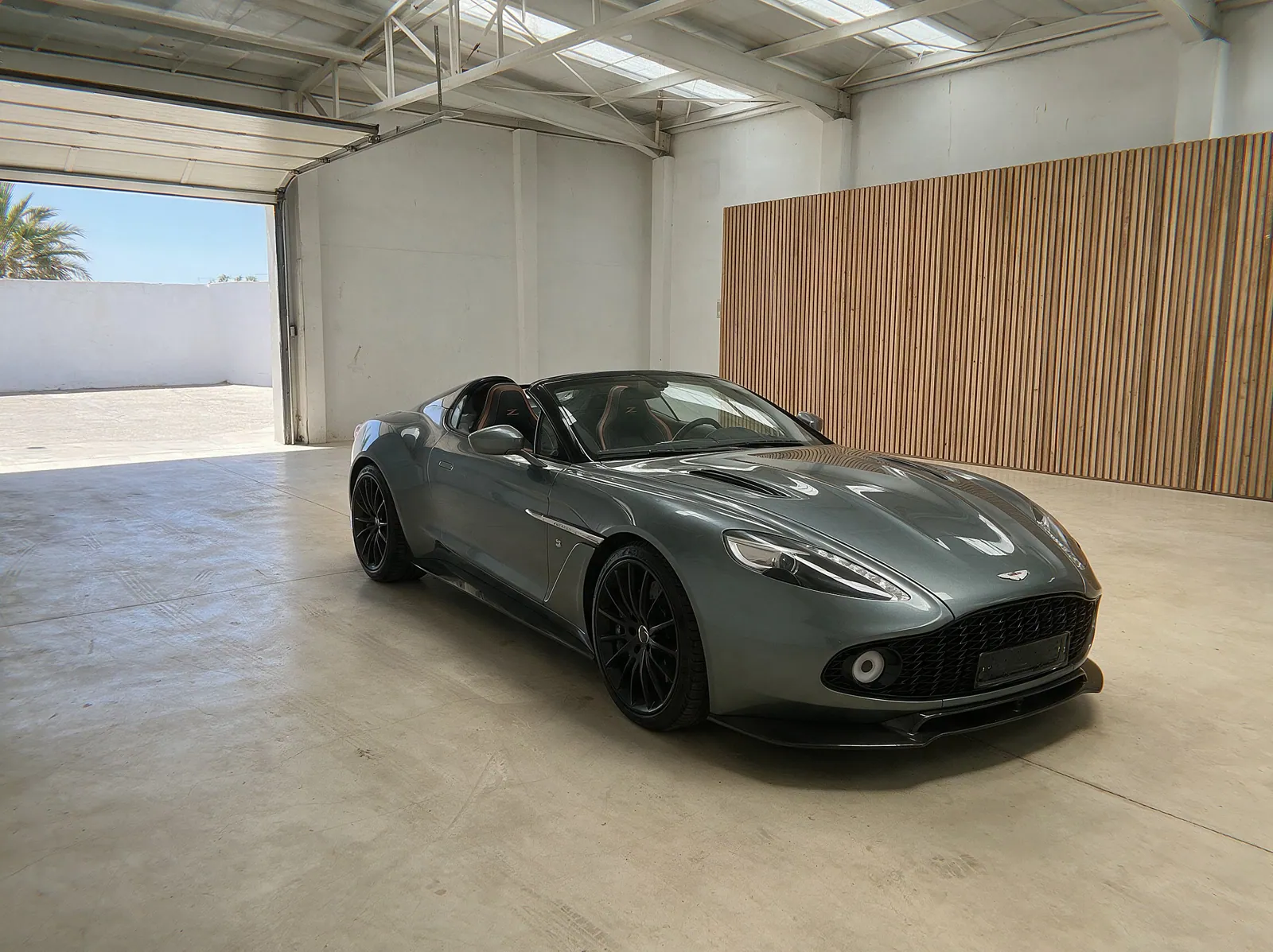
- Under 1,000 km
- 591hppower
- ≈800kmmileage
- 2017first registration
Photos
10 photosWhy this car is special
Model28 cars, the rarest Vanquish ZagatoOf the 325 Vanquish Zagatos, only 28 were Speedsters.
Aston Martin and Zagato built the Vanquish Zagato as a family of four: 99 coupés, 99 Volantes, 99 Shooting Brakes and 28 Speedsters. All 28 Speedsters were sold by August 2017, with deliveries scheduled for 2018.
The partnership dates back to the DB4 GT Zagato of 1960. Andrea Zagato, grandson of the firm's founder, describes it as a creative collaboration that has now spanned three generations of his family.
Aston Martin's Chief Creative Officer, Marek Reichman, said the company could have built more cars to meet demand but chose to keep the Zagatos rare, as future concours cars.
ModelSpeed Humps in place of a roofWith no roof at all, the Speedster carries Zagato's double-bubble signature in its rear cowls.
Aston Martin describes the Speedster as an uncompromising roofless design. Behind the two seats, a pair of Speed Humps rises into streamlined cowls that flow back over the rear deck.
The humps represent Zagato's signature double-bubble roof on a car that has none. On the Shooting Brake, the same motif appears in an extended roof with glass inlays.
Aston Martin calls the Speedster and the Shooting Brake the two extremes of the family: one open and pared back, the other a two-seat GT with a powered tailgate.
ModelEvery body panel in carbon fibreLike the rest of the family, the Speedster is clothed entirely in carbon fibre.
All of the Speedster's body panels are made from carbon fibre, as on the other Vanquish Zagatos.
Shared details tie the four cars together: 'Blade' tail lights inspired by the Aston Martin Vulcan, and three-dimensional Zagato 'Z' motifs repeated in the front grille and rear vent meshes.
Aston Martin presents the four designs as the result of close creative collaboration between its own design team and Zagato.
ModelA 600 PS V12 without turbochargersThe Speedster uses the naturally aspirated 6.0-litre V12 of the Vanquish S.
All four Vanquish Zagatos are based on the Vanquish S, whose 6.0-litre V12 produces 600 PS (592 bhp) without forced induction.
Power goes to the rear wheels through the eight-speed Touchtronic III automatic, which on the Vanquish S could complete a shift in 130 milliseconds.
The Vanquish S underpinnings bring higher spring rates, retuned dampers, a thicker rear anti-roll bar and revised hydraulic steering over the earlier Vanquish, and the adaptive damping was fine-tuned again for the Speedster.
This carTurbine-style tail lightsRed light arranged like turbine blades, set into the rear bodywork.
Zagato and Aston Martin shaped the Vanquish Zagato family around a few sculptural details, and the tail lamps are among the most distinctive. Thin LED elements fan out like the blades of a turbine, giving the rear a precise, graphic signature when lit.
The Speedster was built in a run of only 28. At night, these lamps are how the car is recognised from behind.
This carDouble-bubble humps behind the seatsTwo carbon fairings rising behind the headrests, a long-standing Zagato signature in new form.
Zagato's double-bubble began as a roof with two raised sections, giving room for helmets while keeping the car low. On the Speedster there is no roof, so the idea moves to the rear deck, where two streamlined humps rise behind the occupants.
Here they are carbon, seen from above as a pair of smooth forms leading back to the tail. They make the open car read as a single sculpted piece rather than a coupé with its roof removed.
This carEmbossed Z on the headrestThe Zagato letter pressed into black leather beside the Aston Martin wings.
Zagato, the Milanese coachbuilder founded in 1919, has worked with Aston Martin since the DB4 GT Zagato of 1960. Each collaboration carries the Z as a mark of joint authorship, and here it is embossed directly into the headrest.
Copper piping traces the edge of the black leather, a fine line of warm metal. This car has covered about 800 km.
This carCarbon centre consoleCarbon fibre and glass, with the gears chosen by four buttons.
Aston Martin replaced the conventional gear lever with a row of glass buttons marked P, R, N and D, set into the centre stack. It frees space in the cabin and keeps the console clean, a solution the brand has used across its modern V12 cars.
On the Speedster the stack is exposed carbon fibre, with a screen that rises from the dash when needed. From the driver's seat it sits close at hand, as uncluttered as the open cockpit around it.
Specifications
This car
- First registration
- 09/2017
- Mileage
- ≈ 800 km
- Power
- 591 hp (441 kW)
- Fuel
- Petrol
- Gearbox
- Automatic
- Exterior colour
- Stirling Green
- Location
- Spain
Model
- Engine
- V12, 6.0 litres, naturally aspirated
- Power
- 600 PS (592 bhp)
- Gearbox
- 8-speed Touchtronic III automatic
- Drive
- Rear-wheel drive
- Production
- 28 units; deliveries 2018
Price and next step
Request this car
Leave your e-mail and we will get back to you about this car.