
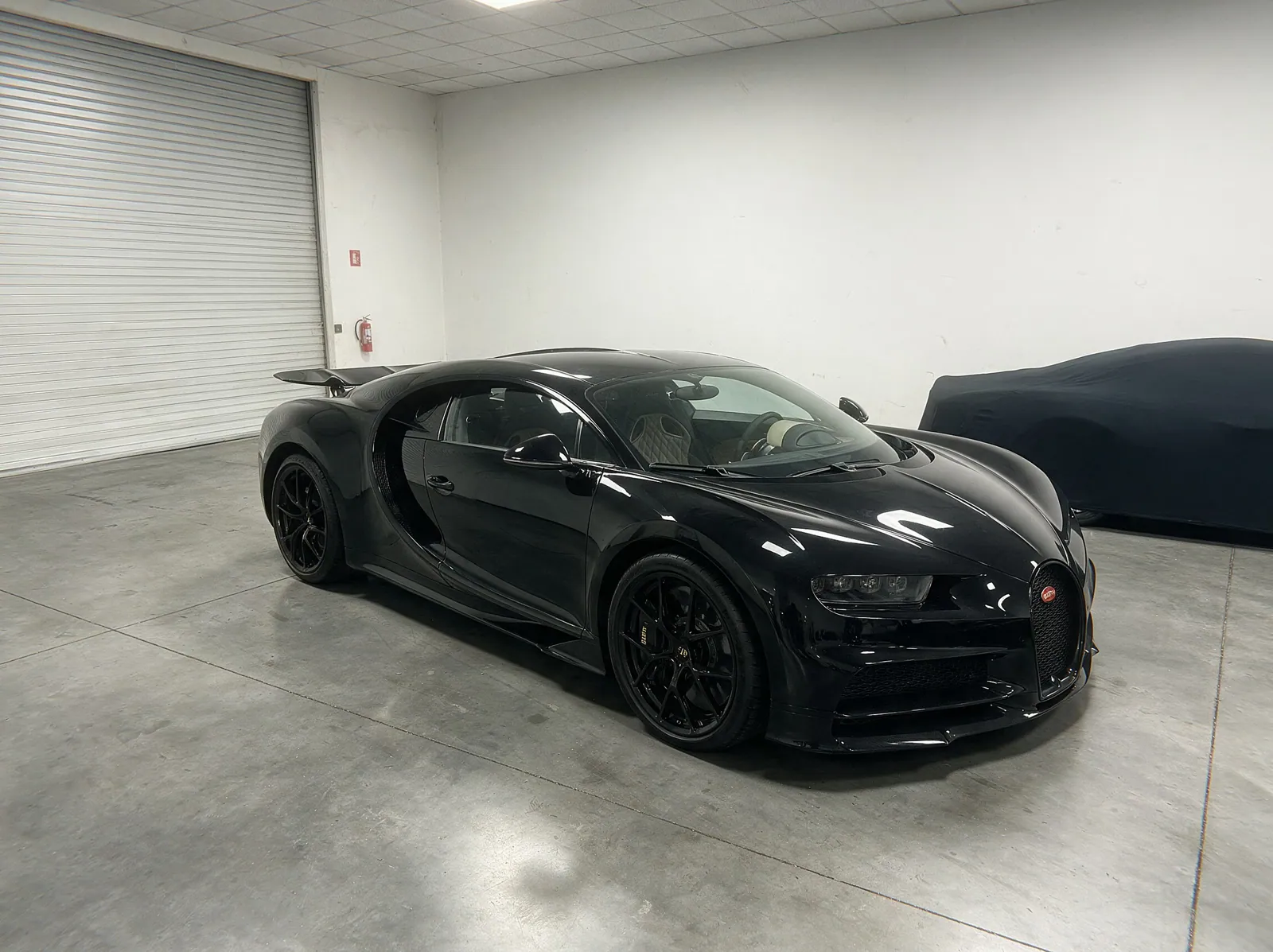
- 1 479hppower
- ≈14 000kmmileage
- 2018first registration
- 3previous owners
Photos
11 photosWhy this car is special
ModelFive seconds faster around NardòWith the same 1,500 PS, the Chiron Sport laps the Nardò handling circuit five seconds quicker than the Chiron.
Bugatti left the engine and performance data unchanged and worked on lateral dynamics instead. A new damper control strategy makes the shock absorbers react on average 10 per cent more stiffly, and the steering was retuned.
The rear differential was optimised and gained Dynamic Torque Vectoring, which distributes torque individually to the wheels on each side to sharpen the car in tight bends. It works in all driving modes, while the stiffer settings apply in Handling mode.
Bugatti uses Nardò as its reference because the Chiron can exploit its full handling potential there at cornering speeds above 200 km/h. The Sport was five seconds faster per lap.
ModelEighteen kilograms lighter, mostly at the wheelsBugatti took about 18 kg out of the Chiron, with the biggest saving from new wheels.
The largest saving comes from the new lightweight ‘Course’ wheels, which also identify the Sport at a glance.
Carbon fibre is used for the anti-roll bar and the intercooler cover, the rear window uses lighter glass, and the exhaust deflector is new and lighter.
The lower weight works together with the chassis changes: Bugatti describes the Sport as perceptibly more nimble, especially in tight corners.
ModelThe first carbon-fibre windscreen wipersThe Chiron Sport was the first production car with wiper arms made of carbon fibre.
The function of the usual articulated joints is built into the carbon structure of the arms, so the joints themselves are gone. The aluminium tips are 3D-printed to save further weight.
The new wipers are 77 per cent, or 1.4 kg, lighter than the previous ones, and the new material allowed a profile with better aerodynamics.
Other details mark the version too: an anodised black start button and drive-mode selector, ‘Sport’ logos on the door sills and an embroidered ‘Chiron Sport’ insert on the centre console.
ModelFour round tailpipes in 3D-printed titaniumThe Chiron Sport replaces the Chiron's rectangular exhaust outlet with four round tailpipes.
The new exhaust deflector with four round pipes is, together with the wheels, the main visual difference from the standard Chiron, and it is lighter than the part it replaces.
Bugatti makes the Chiron Sport's titanium exhaust trim by 3D printing: around 4,200 layers of metal powder are fused on top of one another.
Behind it sits the unchanged powertrain: the 8-litre quad-turbo W16 with 1,500 PS and 1,600 Nm, an electronically limited 420 km/h and 0–100 km/h in 2.4 seconds.
This carChiron Sport lettering on the consoleThe model's name, pressed into beige leather beside the steering wheel.
The Chiron Sport was Bugatti's sharper reading of the Chiron, with lighter components and firmer chassis tuning for more agile handling. Inside, the name is embossed into the leather of the centre console rather than applied as a badge, in keeping with the cabin's restraint.
Here it sits against beige hide and a black wheel, the colours of the whole interior in a single frame. It is a detail you register with your hand on the console as much as with your eyes.
This carHeadrest with Chiron embroiderySilver thread on black leather, above a diamond-quilted beige insert.
The Chiron takes its name from Louis Chiron, the Monégasque driver who raced for Bugatti in the 1920s and 1930s. Embroidered in silver on the headrest, the name sits above a diamond-quilted insert, a pattern that demands patience and precision in the trim shop.
The contrast of black and beige defines this car's interior. From the open door it is the first detail to greet you, and once seated, it is the name closest to your shoulder.
This carBlack wheel and caliper with yellow letteringGloss black spokes, an EB centre cap, and yellow script on a black caliper.
On this car the brake calipers are black, with Bugatti lettering in yellow, set behind gloss black spokes. At the centre cap sit the initials EB, for Ettore Bugatti, who founded the marque in 1909 and whose name still leads every detail of the car.
With black paint, black wheels and black calipers, the yellow is the only bright accent low on the car. It is a small, deliberate glint, visible only to those who look closely.
This carCarbon diffuser and quad exhaustsExposed carbon, four round tailpipes and a single band of red light.
The Chiron's rear diffuser is left in exposed carbon, shaped to draw air from beneath the car at very high speed. Above it the full-width tail light crosses the back, while four round tailpipes sit at the centre, venting the quad-turbocharged W16.
Against gloss black paint, the carbon weave shows only in certain light. From behind, the car looks calm and broad, a composed view of a machine with 1,479 hp.
Specifications
This car
- First registration
- 10/2018
- Mileage
- ≈ 14,000 km
- Power
- 1479 hp (1103 kW)
- Fuel
- Petrol
- Gearbox
- Automatic
- Exterior colour
- Black
- Interior
- Full leather
- Previous owners
- 3
- Location
- Germany
Model
- Engine
- W16, 7,993 cm³, four turbochargers (two-stage), unchanged from the Chiron
- Power
- 1,103 kW (1,500 PS) at 6,700 rpm
- Torque
- 1,600 Nm at 2,000–6,000 rpm
- Gearbox
- 7-speed dual-clutch (DSG)
- Drive
- Permanent all-wheel drive, with Dynamic Torque Vectoring
- 0–100 km/h
- 2.4 s (same as the Chiron)
- Top speed
- 420 km/h, electronically limited
- Weight
- About 18 kg below the Chiron's 1,995 kg (DIN empty)
- Production
- Part of the 500-car Chiron run, 2016–2024; Les Légendes du Ciel edition: 20 cars
Price and next step
Request this car
Leave your e-mail and we will get back to you about this car.