
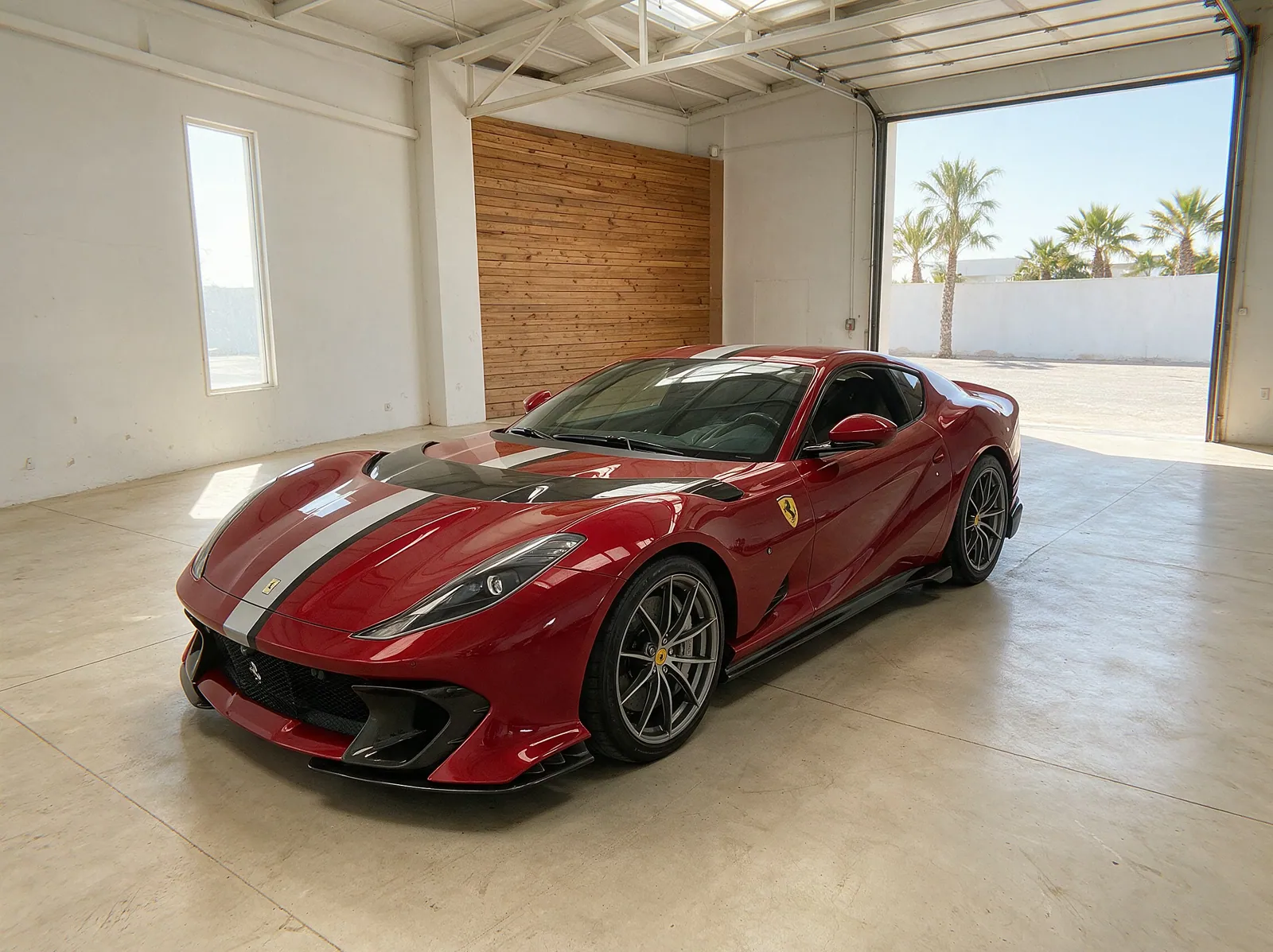
- Ferrari Atelier
- special paint
- Limited series
- Full service history
- 818hppower
- ≈10 000kmmileage
- 2023first registration
Photos
10 photosWhy this car is special
ModelAluminium in place of the rear windowFerrari gave up the rear window for the sake of downforce.
The 812 Competizione has no rear glass: in its place is an all-aluminium panel carrying three pairs of profiled vanes. Ferrari describes it as the first completely closed rear screen on a production car, and the design is patented.
The vanes act as vortex generators, redistributing the pressure field over the rear axle and steering part of the flow towards the sides of the spoiler. According to Ferrari, they alone deliver 10% of the total rear-downforce gain over the 812 Superfast.
Rearward vision passes to a camera system. Without glass, roof and spoiler form one continuous surface, which Ferrari notes allows a single livery to run the car's full length.
Model830 cv and a 9,500 rpm red lineFerrari rated this 6.5-litre V12 at 830 cv, the highest output of any of its road-car engines at the time.
The engine develops 610 kW (830 cv) at 9,250 rpm and revs to 9,500 rpm, 500 rpm more than the 812 Superfast and, by Ferrari's account, the highest of any Ferrari combustion engine.
To get there, Ferrari fitted titanium connecting rods 40% lighter than steel ones, a crankshaft 3% lighter than before, and DLC-coated sliding finger followers derived from Formula 1.
Variable-geometry intake tracts change their length continuously to keep the torque curve full across the rev range, and the seven-speed dual-clutch gearbox shifts 5% faster than in the Superfast.
ModelIndependent rear steering, a Ferrari firstThe 812 Competizione was the first Ferrari whose rear wheels steer independently of each other.
A new electronic system drives the left and right rear actuators individually rather than in sync. Ferrari says this sharpens the front axle's response while the rear keeps a sense of grip and follows promptly.
The function sits within Virtual Short Wheelbase 3.0 and is coordinated by Side Slip Control 7.0, which also governs the E-Diff 3.0, F1-Trac and magnetorheological suspension control.
Ferrari also developed dedicated Michelin Cup2R tyres for the car, and quotes a Fiorano lap time of 1 minute 20 seconds.
Model38 kg lighter than the 812 SuperfastFerrari took weight out of the engine, running gear, body and cabin.
Carbon fibre is used for the front and rear bumpers, rear spoiler and air intakes. In the powertrain, titanium con-rods, a lighter crankshaft and a 12-volt lithium-ion battery add to the saving.
The cabin uses carbon trim, lightweight technical fabrics and reduced sound-proofing. Even the redesigned oil tank holds over a kilogram less oil than the Superfast's.
For the first time on a Ferrari V12, all-carbon wheels were offered, 3.7 kg lighter in total than the Superfast's forged rims. Their inner surfaces carry a white aerospace-derived coating that reflects heat from the brakes.
This carCarbon splitter and air intakesA carbon blade at road level, with finned intakes cut into the bumper.
The 812 Competizione reworks the aerodynamics of the 812 Superfast to suit more power and higher revs. At the front, the splitter guides air beneath the car, while carbon fins in the intakes direct the flow toward the radiators and brakes.
The carbon front air vents were specified for this car in the factory option list. Against Rosso Magma, a special four-layer Atelier colour, the dark weave sharpens the line of the nose.
This carCarbon steering wheel with LED rev lightsA row of coloured lights along the rim, counting toward the V12's limit.
The 812 Competizione's naturally aspirated 6.5-litre V12 revs to 9,500 rpm, and its shift lights sit on top of the wheel, within the driver's line of sight. The idea comes from Formula 1: the eyes stay on the road while the lights signal the moment to change gear.
On this car the rim is carbon, with a silver marker at the centre. As the engine climbs toward its limit, the row fills with red and blue light.
This carBucket seats with 4-point harnessesBlack Alcantara racing seats, fitted with four-point harnesses for the circuit.
Ferrari's Daytona racing seats are shaped shells with minimal padding, made to locate the body rather than cushion it. Paired with four-point belts, they hold driver and passenger firmly, so the body stays still while the car works through a corner.
Both were specified for this car in the factory option list, the seats in the large size and the harnesses in black. Red strap loops add a single note of colour.
This carRear diffuser and exhaustCarbon at the base of the tail, beneath twin round lamps and side louvres.
The diffuser accelerates air leaving the underbody, drawing the car toward the road at speed. On the 812 Competizione it works with a reshaped tail, including the aluminium panel with vortex generators that takes the place of a rear window.
The rear diffuser in carbon was specified for this car in the factory option list. Low behind the corner, this is where the V12's sound and the car's aerodynamic work meet.
Car passport
Options from the factory list as given in the original listing. Codes as provided there.
Exterior 13
EXTCRosso Magma paintALO1Airbrushed Scuderia Ferrari shieldsATELAtelier carCALABrake calipers in AlluminioCEFBCarbon fibre filter boxCEL2Carbon fibre engine coversCEXDCarbon fibre rear diffuserCEXGCarbon fibre front air ventsCEXSCarbon fibre underdoor coverHBMBMatte black rear CavallinoHBSACavallino and satin Ferrari badgesPNTESpecial four-layer paintRMDR20-inch forged diamond racing wheels
Interior 18
INTCNero Alcantara interior4HANBlack four-point harnessesCIDHCarbon fibre inner door handlesCITZCarbon fibre upper centre consoleCLDTColoured interior detailsCLDXColoured interior details in leatherDATRCarbon fibre dashboard insertsDLPASingle-colour Dreamline on the F1 paddlesEMPHCavallino stitched on headrests in RossoFLMAAdditional coloured mats with logoLITUTricolore stripe on the steering wheel rimRPMAAluminium rev counterRSCDLarge Daytona racing seatsRSESRacing seat lifterST2XColoured stitching in special threadSTC2Coloured special stitchingSTP1Perforated leather insertsSTPXPerforated inserts in Rosso FX leather
Technology and comfort 7
ACPLApple CarPlayAFS2Adaptive headlights with SBL functionELEVSuspension lift systemHAW1Heat-insulating windscreenPAC3Front and rear parking camerasPDISPassenger displaySNDBHigh-power hi-fi system
Specifications
This car
- First registration
- 01/2023
- Mileage
- ≈ 10,000 km
- Power
- 818 hp (610 kW)
- Fuel
- Petrol
- Gearbox
- Automatic
- Exterior colour
- Red metallic
- Interior
- Alcantara
- Service history
- Full, according to the seller
- Individual programme
- Ferrari Atelier, special paint, Limited series
- Location
- Netherlands
Model
- Engine
- V12 65°, 6,496 cc, naturally aspirated
- Power
- 610 kW (830 cv) at 9,250 rpm; 9,500 rpm limit
- Torque
- 692 Nm at 7,000 rpm
- Gearbox
- 7-speed dual-clutch (F1 DCT)
- Drive
- Rear-wheel drive
- 0–100 km/h
- 2.85 s
- Top speed
- Over 340 km/h
- Weight
- 1,487 kg dry (with optional equipment)
- Production
- 999 units; unveiled May 2021
Price and next step
Request this car
Leave your e-mail and we will get back to you about this car.