
- Non-smoker
- Under 5,000 km
- 949hppower
- ≈2 000kmmileage
- 2014first registration
- 2previous owners
Photos
13 photosWhy this car is special
ModelHY-KERS: hybrid power on Formula 1 linesThe LaFerrari was Ferrari's first hybrid road car, and its electric motor exists purely to add performance.
The HY-KERS system draws on Ferrari's Formula 1 KERS experience. A 120 kW (163 cv) electric motor drives the rear wheels through the differential alongside the 6.3-litre V12's 800 cv, for a combined 963 cv.
Unlike many hybrids, the car has no electric-only mode. The motor fills torque gaps at low revs, which let Ferrari tune the V12 for top-end power: 800 cv at 9,000 rpm and a 9,250 rpm limit.
Ferrari quotes 0–100 km/h in under 3 seconds, 0–300 km/h in 15 seconds and a top speed above 350 km/h. The LaFerrari remained Maranello's most powerful car until the SF90 Stradale of 2019.
ModelA chassis built with Formula 1 materialsFerrari's road-car and Formula 1 engineers designed the LaFerrari's carbon chassis together.
The GT and F1 engineering teams worked hand in hand from the outset, and Rory Byrne, designer of 11 championship-winning Ferrari F1 cars, contributed to the design. The materials were the same as on a Grand Prix car.
According to Ferrari, the chassis had 27% more torsional rigidity than the Enzo's while being 20% lighter. Ferrari's technical team told Autocar India it used T800 and T1000 grade carbon fibre, against T700 on the Enzo.
The LaFerrari keeps the Enzo's wheelbase and overall length, yet also packages the hybrid system and a dual-clutch gearbox without impinging on cabin space.
ModelThe seat is fixed; the car fits the driverAs in a racing car, the LaFerrari's seat does not slide; the pedals come to the driver instead.
The seat is fixed to the structure and padded to suit each owner, while the pedal box adjusts to the driver's reach.
Ferrari's engineers gave two reasons: in a crash the occupant's trajectory is defined more precisely, and the driver's weight always sits in the same place, which helps weight distribution.
The layout keeps mass central: cabin and engine sit within the wheelbase, and Ferrari quotes a 41% front and 59% rear weight distribution.
ModelAerodynamics that work out of sightThe LaFerrari was the first Ferrari road car to integrate its dynamic controls with active aerodynamics.
Automatically adjusting flaps in the front and rear diffusers, a guide vane under the nose and an integrated rear spoiler move as needed to add downforce or cut drag.
Because most of the work happens beneath the car, the upper body needed no large wings. Ferrari's own magazine notes hints of 1960s sports racers such as the 330 P4 in its lines.
The result showed on the stopwatch: at Fiorano, the LaFerrari lapped 5.2 seconds faster than its predecessor, the Enzo.
This carLimited Edition 1 of 499 plaqueA small brushed-metal plate on carbon, stating how few coupés were made.
Ferrari limited LaFerrari coupé production to 499 cars, and this plaque marks the car as one of them. Set into glossy carbon weave, it is understated by design, with no flourish beyond the words themselves, in the same material language as the rest of the car.
It is the kind of detail an owner rarely points out and never stops noticing. It places the car in a small circle, among the defining Ferraris of its decade.
This carHybrid V12 under glassFerrari's first hybrid road car, its naturally aspirated V12 displayed like an exhibit.
LaFerrari pairs a 6.3-litre naturally aspirated V12 with an electric motor, a system Ferrari called HY-KERS, for a combined 949 hp. It was the first hybrid road car to carry the prancing horse, and the engine sits beneath glass so it stays visible even at rest.
From above the rear deck, the carbon intake covers, red striping and orange high-voltage cables read like a cutaway of the car's idea. Lifting the lid shows two eras of Ferrari in a single bay.
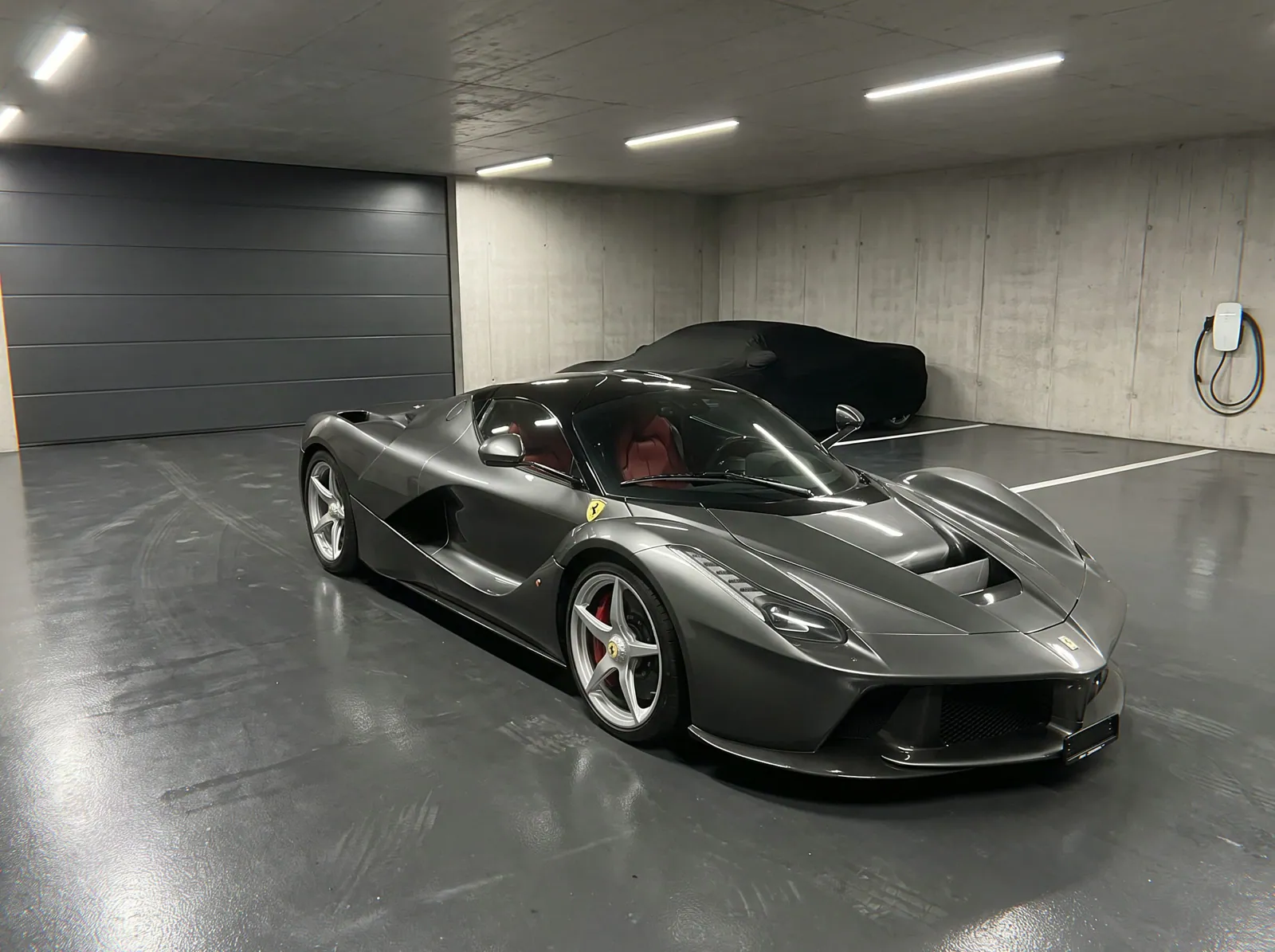
This carNose with carbon splitterA low, sculpted face where every intake and edge serves the airflow.
LaFerrari was shaped around active aerodynamics: flaps and guide vanes beneath the car adjust with speed, alongside a deployable rear spoiler. The carbon front splitter and honeycomb intakes seen here feed cooling air and manage the flow that runs under the floor.
On this car the dark grey paint and exposed carbon keep the face severe and quiet. From a low three-quarter angle it still looks like a design study, more than a decade after it first appeared.
This carForged wheels and carbon-ceramic brakesSilver forged spokes open onto red calipers and drilled carbon-ceramic discs.
The option list confirms forged alloy wheels, 19 inches at the front and 20 at the rear, and Brembo carbon-ceramic brakes. Forging keeps unsprung mass low, which sharpens how the car rides and steers, while carbon-ceramic discs resist fade through repeated hard stops.
The five-spoke design leaves the brake fully on view, red caliper against grey disc. It is a reminder, even at a standstill, of the speed this car is built to shed.
Car passport
Exterior 6
- Exterior in Grigio Silverstone
- Forged alloy wheels, 19 and 20 inch
- Carbon fibre monocoque
- Brembo carbon-ceramic brakes
- Sports exhaust
- Carbon fibre elements
Interior 1
- Red leather interior with black details
Technology and comfort 7
- 6.3-litre naturally aspirated V12 with electric assistance
- Combined output of 950 hp
- Seven-speed dual-clutch automatic gearbox
- E-Diff3 electronic differential
- Electromagnetic dampers
- Rear-view camera
- Parking sensors
Specifications
This car
- First registration
- 09/2014
- Mileage
- ≈ 2,000 km
- Power
- 949 hp (708 kW)
- Fuel
- Hybrid (petrol / electric)
- Gearbox
- Automatic
- Exterior colour
- Grey
- Previous owners
- 2
- Location
- Spain
Model
- Engine
- V12 65°, 6,262 cc, naturally aspirated, with HY-KERS hybrid system
- Power
- 963 cv combined; V12 800 cv at 9,000 rpm; electric motor 120 kW (163 cv)
- Torque
- Over 900 Nm combined; V12 700 Nm at 6,750 rpm
- Gearbox
- 7-speed dual-clutch
- Drive
- Rear-wheel drive
- 0–100 km/h
- Under 3 s
- Top speed
- Over 350 km/h
- Production
- 499 units, unveiled 2013; a 500th car was built and auctioned for charity in 2016
Price and next step
Request this car
Leave your e-mail and we will get back to you about this car.