
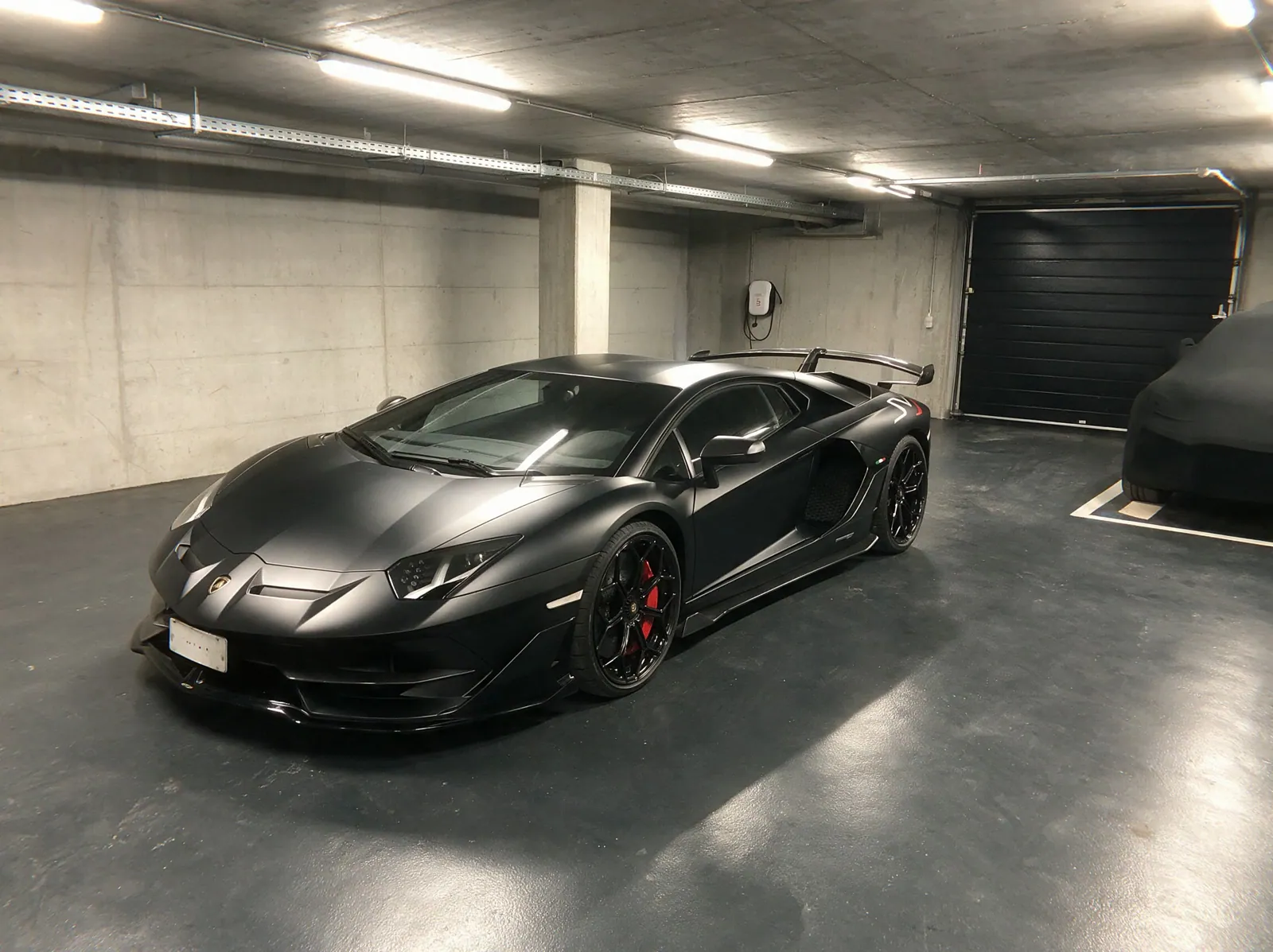
- Lamborghini Ad Personam
- Limited series
- Under 1,000 km
- 759hppower
- <100kmmileage
- 2025first registration
Photos
9 photosWhy this car is special
ModelA rear wing that loads one side at a timeOn the SVJ, the active aerodynamics can work on the left and right halves of the wing separately.
The rear wing's inner air channel is split into left and right. In a fast corner the LDVA 2.0 control unit switches ALA on for one side only, adding downforce and traction on the inner wheel and countering the load transfer as the body rolls.
Lamborghini calls this aero vectoring. On the SVJ it was developed further, so the loading effect on the inner wheel is 30% greater than in the original system and the car needs less steering angle for the same corner.
The ALA 2.0 flaps, in the front splitter and on the engine cover, open or close in under 500 milliseconds. With ALA off they hold the car down for braking and cornering; with ALA on they cut drag for acceleration and top speed.
Model40% more downforce than the SVThe SVJ's bodywork was redrawn around one goal: more grip from the air without more drag.
Compared with the Aventador SV, downforce rose by 40% on both axles while the drag coefficient improved by 1%. Lamborghini attributes 70% of the gain to the upper body and 30% to the underbody, diffusers and vortex generators.
The high-mounted rear wing is made entirely of carbon fibre with ALA integrated. The engine cover is also carbon fibre and is held by quick-release clips, a direct reference to motor racing.
The chassis was retuned to match: anti-roll bars 50% stiffer than on the SV, a 15% wider damping range, and 3% more torque sent to the rear axle.
Model770 CV from a V12 without turbochargersAt its launch the SVJ had the most powerful series-production V12 Lamborghini had built.
The naturally aspirated 6.5-litre V12 delivers 566 kW (770 CV) at 8,500 rpm and 720 Nm at 6,750 rpm. With a dry weight of 1,525 kg, each horsepower carries just 1.98 kg.
The gains came from titanium intake valves, intake runners of a new shape and length, and a reworked intake duct in the cylinder head for better flow. A new, lighter exhaust exits high at the rear, close to the engine, which also saves weight.
The seven-speed ISR gearbox was recalibrated for the extra power and torque. Lamborghini quotes 0–100 km/h in 2.8 seconds, 0–200 km/h in 8.6 seconds and more than 350 km/h flat out.
Model6:44.97 around the NordschleifeBefore it was even unveiled, the SVJ took the production-car lap record at the Nürburgring.
On 26 July 2018 Lamborghini announced that a camouflaged SVJ, driven by factory driver Marco Mapelli, had lapped the 20.6 km Nordschleife in 6:44.97, a record for production cars.
The lap was timed and GPS-certified by Remak personnel with VBOX-Racelogic equipment, with cameras inside and out. For the attempt the car wore the optional road-legal Pirelli P Zero Trofeo R tyres; the standard P Zero Corsa was developed specifically for the SVJ.
The time beat the 6:47.3 of the Porsche 911 GT2 RS. The 'Jota' suffix in the name, in Lamborghini's words, denotes the car's track and performance superiority.
This carAventador SVJ 1 di 900 plaqueA numbered plate behind the glass, beside the Italian tricolour.
Lamborghini built the Aventador SVJ coupé in a run of 900 cars, and each carries a plaque recording its place in the series. Set behind the side glass with the tricolour, it is the car's own statement of origin in Sant'Agata Bolognese.
This example has covered under 100 km. The plaque is visible from outside the car, a quiet record of the limited series it belongs to.
This carALA rear wing and exhaustA carbon wing with moving flaps, above exhausts placed high at the tail.
ALA, Aerodinamica Lamborghini Attiva, uses flaps inside the wing to reduce drag or add downforce, and can load one side more than the other to help the car turn. The exhausts exit high through the rear, close to the naturally aspirated V12 they serve.
Against matte black, the Y-shaped tail lamp and hexagonal mesh read almost as relief. From the rear corner, this view shows the SVJ at its most purposeful.
This carCarbon centre consoleA red flap over the start button, and switches for every driving mode.
Lamborghini styled the Aventador's start control after a fighter aircraft's weapons switch: a red cover lifts before the button can be pressed. Beside it, switches select the driving modes Strada, Sport, Corsa and Ego, the last letting the driver combine settings.
Here the console is carbon, set against black Alcantara. Starting the V12 becomes a small, deliberate act each time.
This carSeats with red Y-patternBlack Alcantara crossed with red Y-shaped stripes and an embroidered shield.
The Y is a recurring Lamborghini motif, carried through headlamps, tail lamps and wheels. Stitched into the seat, it brings the same language into the cabin, and the embroidered shield completes it.
Red picks up the calipers and the red in the SVJ graphic on the body. Seen through the open door, it is the warmest colour in an otherwise black car.
Specifications
This car
- First registration
- 05/2025
- Mileage
- under 100 km
- Power
- 759 hp (566 kW)
- Fuel
- Petrol
- Gearbox
- Semi-automatic
- Exterior colour
- Black
- Interior
- Alcantara
- Individual programme
- Lamborghini Ad Personam, Limited series
- Location
- Italy
Model
- Engine
- V12, 6,498 cm³, naturally aspirated
- Power
- 566 kW (770 CV) at 8,500 rpm
- Torque
- 720 Nm at 6,750 rpm
- Gearbox
- 7-speed ISR robotised (Independent Shifting Rods)
- Drive
- All-wheel drive, rear-wheel steering
- 0–100 km/h
- 2.8 s
- Top speed
- Over 350 km/h
- Weight
- 1,525 kg dry
- Production
- 900 units, plus 63 SVJ 63; unveiled 2018
Price and next step
Request this car
Leave your e-mail and we will get back to you about this car.