
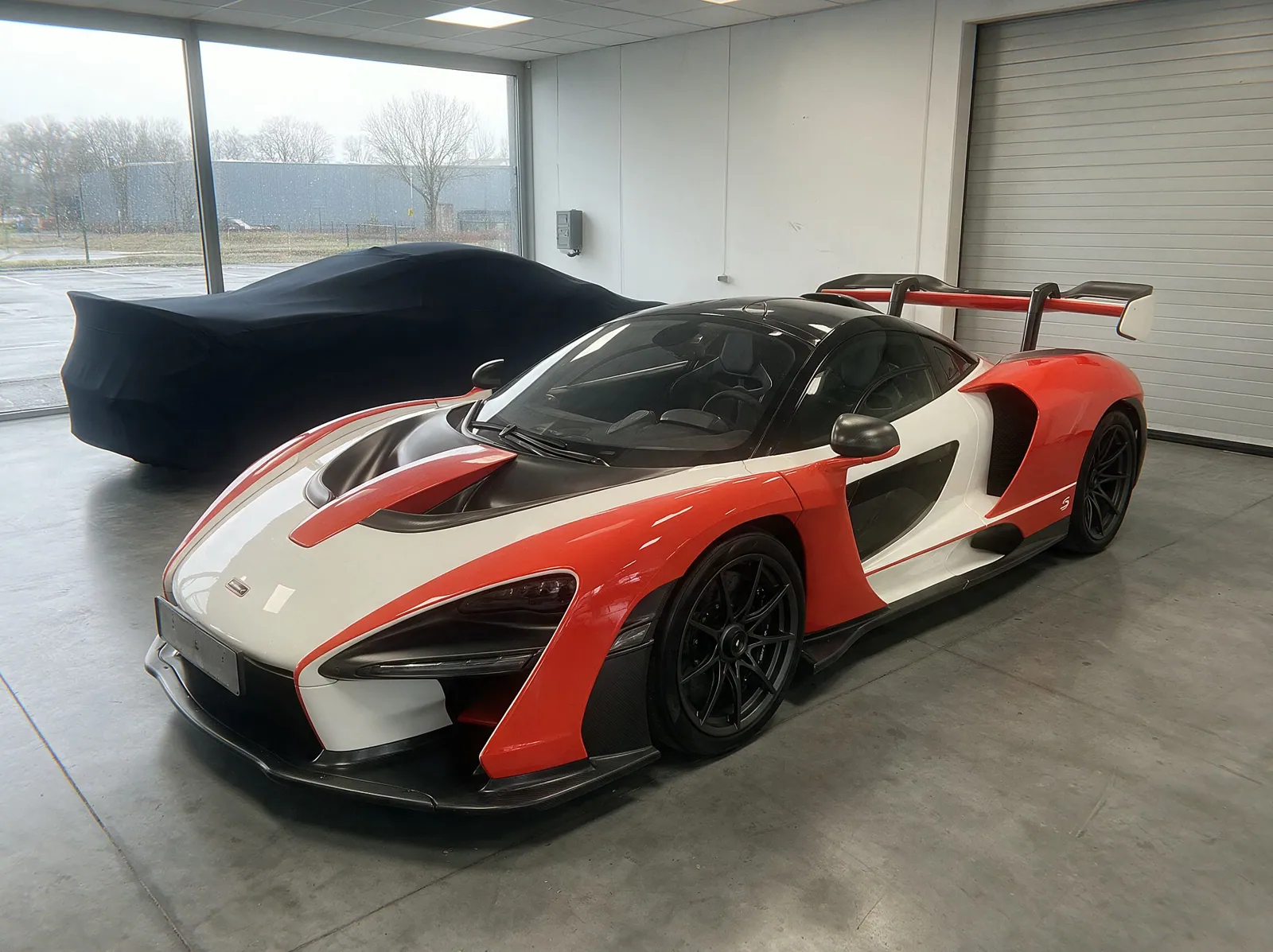
- McLaren Special Operations
- Full service history
- 789hppower
- ≈18 000kmmileage
- 2019first registration
Photos
10 photosWhy this car is special
Model800 kg of downforce by 250 km/hAerodynamics dictated the Senna's shape: it generates 800 kg of downforce by 250 km/h.
Active flaps and winglets inside the front intakes direct air either under and through the body for downforce, or into the radiators and oil coolers. Turbulent air in the front wheel arches is drawn out through openings behind them.
The hydraulic rear wing moves constantly, through 25 degrees in 0.3 to 0.7 seconds depending on speed. At its highest it stands 1.2 metres above the ground, and it also works as an airbrake and as a drag reduction system.
evo reports that the 800 kg figure is reached by 155 mph (250 km/h), 40 per cent more than the P1. Above that speed McLaren alters the wing angle to favour acceleration.
ModelA 4.87 kg wing that holds 100 times its weightEvery body panel on the Senna is carbon fibre, and its engineers counted the grams in each part.
The rear wing weighs 4.87 kg yet can support up to 100 times its own weight. Each carbon seat shell weighs 3.35 kg, and the doors weigh half as much as those of a 720S.
The structure is Monocage III, McLaren's lightest and stiffest carbon tub at the time. Dry weight is 1,198 kg; Top Gear puts the car at around 1,300 kg with all fluids and fuel.
The cabin follows the same logic: the door release is a switch in the roof, nothing is fixed to the doors apart from the gas strut, and the gearbox controls are mounted on the driver's seat and move with it.
ModelThe M840TR: 800 PS from four litresThe M840TR was the most powerful version yet of McLaren's twin-turbo V8 when the Senna appeared.
Compared with the 720S, the engine gained new camshafts and pistons, two fuel pumps instead of one and additional sensors. Air enters through the roof snorkel and a new carbon-fibre intake plenum that sharpens throttle response.
Output is 800 PS (789 bhp) at 7,250 rpm and 800 Nm from 5,500 to 6,700 rpm, 79 bhp and 47 lb ft more than the 720S. Power goes to the rear wheels through a seven-speed dual-clutch gearbox.
Exhaust gases leave through an Inconel and titanium system that exits on top of the rear deck, routed so it does not disturb the rear wing. Stiffer engine mounts send a distinct vibration to the driver at certain revs.
ModelBrake discs that take seven months to makeThe Senna's carbon-ceramic discs take seven months to manufacture instead of one.
The latest-generation carbon-ceramic brakes reach their peak operating performance at a temperature 150 degrees lower than McLaren's usual ceramic discs, and they are lighter.
From 200 km/h (124 mph) the Senna comes to a halt in 100 metres.
The brakes sit behind nine-spoke centre-lock wheels on McLaren-specific Pirelli Trofeo R tyres. The car is named after Ayrton Senna, and all 500 were spoken for when it was announced.
This carHeadlight and carbon air ductA small light unit inside a large carbon opening, where airflow sets the form.
The Senna was designed with aerodynamics ahead of appearance, and its headlights show it: compact units set within deep openings that guide air through the nose. McLaren built 500 road-going examples, each around a carbon-fibre structure.
On this car the carbon surround meets an orange-red fender edge and an exposed carbon splitter, part of a specification from McLaren Special Operations. Seen up close, the corner reads as one object, colour and carbon working together.
This carCarbon bonnet cut-outsOpenings cut straight through the bonnet, framed in exposed carbon.
Air that has passed through the front of the Senna has to leave somewhere, and the bonnet vents give it a short, clean exit. Releasing it over the top helps the nose stay planted, which matters on a machine built for the circuit first.
Here the carbon edges sit beside an orange-red centre stripe on white paint, so the most functional part of the body is also the most graphic. Standing over the nose, you see how little of the Senna is there for decoration.
This carS logo and carbon sillThe Senna emblem in white, drawn across an orange-red flank.
The stylised S is the model's own emblem, separate from the McLaren logo. Below it, the carbon sill shows the material of the structure beneath the paint: the Senna is built around a carbon-fibre monocoque, and here that is left in plain view.
On this car the emblem sits on an orange-red flank with a fine white pinstripe, just ahead of the rear wheel. It is a small, precise piece of graphic work, the kind of detail that rewards a closer look.
This carCentre-lock wheelA single central fixing, borrowed from motorsport and finished in satin black.
A centre-lock wheel is held by one large nut instead of a ring of bolts, a solution taken from racing, where wheels must come off quickly and precisely. On the Senna it suits a car whose every component was weighed against its purpose.
Here the McLaren cap sits on a satin black wheel with a black caliper behind it, a deliberately dark combination against the white and orange-red body. The effect is purposeful and calm, leaving the livery to speak.
Specifications
This car
- First registration
- 05/2019
- Mileage
- ≈ 18,000 km
- Power
- 789 hp (588 kW)
- Fuel
- Petrol
- Gearbox
- Automatic
- Interior
- Alcantara
- Service history
- Full, according to the seller
- Individual programme
- McLaren Special Operations
- Location
- Netherlands
Model
- Engine
- V8, 4.0 litres, twin-turbo (M840TR)
- Power
- 588 kW (800 PS / 789 bhp) at 7,250 rpm
- Torque
- 800 Nm at 5,500–6,700 rpm
- Gearbox
- 7-speed dual-clutch
- Drive
- Rear-wheel drive
- 0–100 km/h
- 2.8 s
- Top speed
- 340 km/h (211 mph)
- Weight
- 1,198 kg (dry)
- Production
- 500 cars
Price and next step
Request this car
Leave your e-mail and we will get back to you about this car.