
- Limited series
- Warranty
- Non-smoker
- One owner
- Under 1,000 km
- 1 033hppower
- <100kmmileage
- 2022first registration
- 1previous owners
Photos
9 photosWhy this car is special
ModelThe driver sits in the middleLike the McLaren F1, the Speedtail has three seats, with the driver in the centre.
Getting in means sliding across a passenger seat, helped by recessed handles in the headlining. Because the central seat could not have high bolsters, McLaren engineered ‘directional’ leather that eases the driver in and then holds them in place.
The view ahead is symmetrical and uncluttered: instead of sun visors, electrochromic glass darkens at the touch of a button. Start/stop, gear selection and drive modes sit in a panel above the driver's head.
One of those switches is labelled Velocity. It lowers the car, optimises the active aerodynamics and folds away the camera arms for high-speed running.
ModelNo mirrors, and covers over the wheelsThe Speedtail is shaped for low drag rather than downforce, and McLaren calls it its most drag-efficient car.
The body is 5.13 metres long; design chief Rob Melville describes it as a comet, with the mass at the front and a long tail. Wheel covers stay static as the wheels turn, and air escapes the arch only through a single notch.
There are no exterior mirrors: pop-out cameras sit at the base of the A-pillars. At the rear, sections of flexible carbon fibre are moved by hydraulic actuators to adjust the centre of pressure and aid stability under braking.
A prototype reached the 403 km/h top speed more than 30 times on the former Space Shuttle landing strip at Kennedy Space Center in Florida, with Kenny Bräck driving.
Model1,070 PS from a petrol-electric powertrainA twin-turbo V8 and an electric motor gave the Speedtail the highest power and torque of any McLaren road car at the time.
The hybrid powertrain combines a 4.0-litre twin-turbo V8 with an electric motor for 1,070 PS (1,055 bhp) and 1,150 Nm. Drive goes to the rear wheels only, through a dual-clutch gearbox.
McLaren states that the battery system achieves a power density of 5.2 kW/kg, the best power-to-weight ratio of any automotive high-voltage battery system. There is no plug-in socket.
At the reveal McLaren gave 0–300 km/h in 12.8 seconds. For comparison, Top Gear noted that the McLaren F1 took 22.0 seconds and the P1 16.5 seconds.
ModelCarbon fibre with a skin of titaniumMcLaren developed Titanium Deposition Carbon Fibre for the Speedtail.
A micron-thin layer of titanium is fused onto the carbon weave. This avoids colouring the carbon itself, which can compromise its structural integrity, and the titanium can be anodised in any colour or carry images and lettering.
The steering wheel and paddles are machined from billet carbon built up in layers 30 microns thick, giving a wood-like finish.
The leather has air infused beneath its surface during manufacture, cutting its weight by 30 per cent, yet it is tough enough to replace carpet on the floor.
This carPerforated carbon engine coverA rear deck drilled through, so the hybrid V8 beneath it can breathe.
The Speedtail pairs a twin-turbocharged V8 with electric power, and both produce heat that must leave the car without spoiling its long, clean tail. The perforated carbon deck and its two vents release it quietly, while a silver spine runs down the centre as the one bright line.
Only 106 Speedtails were built, and this is number 007. With under 100 km recorded, the deck has barely known the heat it was designed to release.
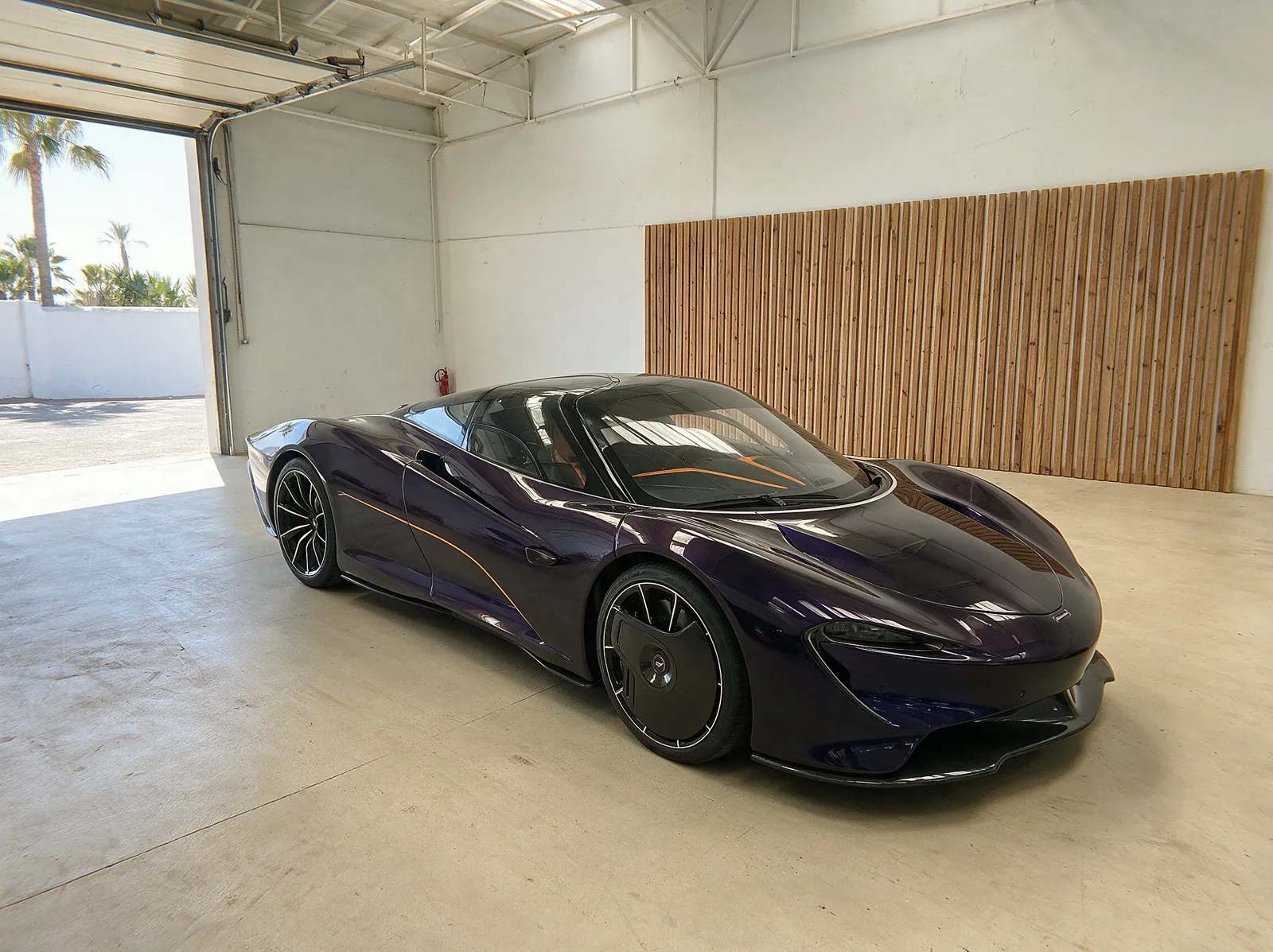
This carCarbon front wheel fairingsFixed carbon discs over the front wheels that stay still while the wheels turn.
At very high speed a spinning wheel churns the air around it. McLaren's answer was a static carbon cover mounted to the front hub, which stays in place as the wheel rotates beneath and keeps the flow smooth along the body. It is one of several measures behind the Speedtail's 403 km/h top speed.
Each cover carries the McLaren logo, upright and still at any speed. From the side it gives the car the unbroken surface of a streamliner.
This carNose and carbon splitterA narrow nose with slim headlamps, the leading point of a long teardrop.
The Speedtail was drawn around low drag rather than outright downforce, and the nose sets that brief in motion. Slim headlamps sit flush within the bodywork, and a carbon splitter below guides air beneath the car instead of letting it pile up in front.
Against deep violet, the carbon and the small McLaren badge are the only interruptions. Behind the nose, a fine orange pinstripe runs along the flanks toward the tail.
This carButterfly doorsTwo doors rise from the roofline, opening the way to a three-seat cabin.
The doors lift up and out, taking part of the roof with them so entry is possible into a low, enclosed cabin. Inside, the driver sits at the centre, with a passenger seat set slightly behind on each side, a layout McLaren had not used since the F1.
Raised, the doors show how long the tail behind them is. For the owner, every arrival begins with the same unhurried movement upward.
Specifications
This car
- First registration
- 06/2022
- Mileage
- under 100 km
- Power
- 1033 hp (770 kW)
- Fuel
- Hybrid (petrol / electric)
- Gearbox
- Automatic
- Exterior colour
- Violet
- Interior
- Full leather
- Previous owners
- 1
- Warranty
- Yes, according to the seller
- Individual programme
- Limited series
- Location
- Germany
Model
- Engine
- V8, 4.0 litres, twin-turbo, plus electric motor (hybrid)
- Power
- 787 kW (1,070 PS / 1,055 bhp) combined
- Torque
- 1,150 Nm combined
- Gearbox
- Dual-clutch
- Drive
- Rear-wheel drive
- Top speed
- 403 km/h (250 mph)
- Weight
- 1,430 kg (dry)
- Production
- 106 cars, deliveries from February 2020
Price and next step
Request this car
Leave your e-mail and we will get back to you about this car.