
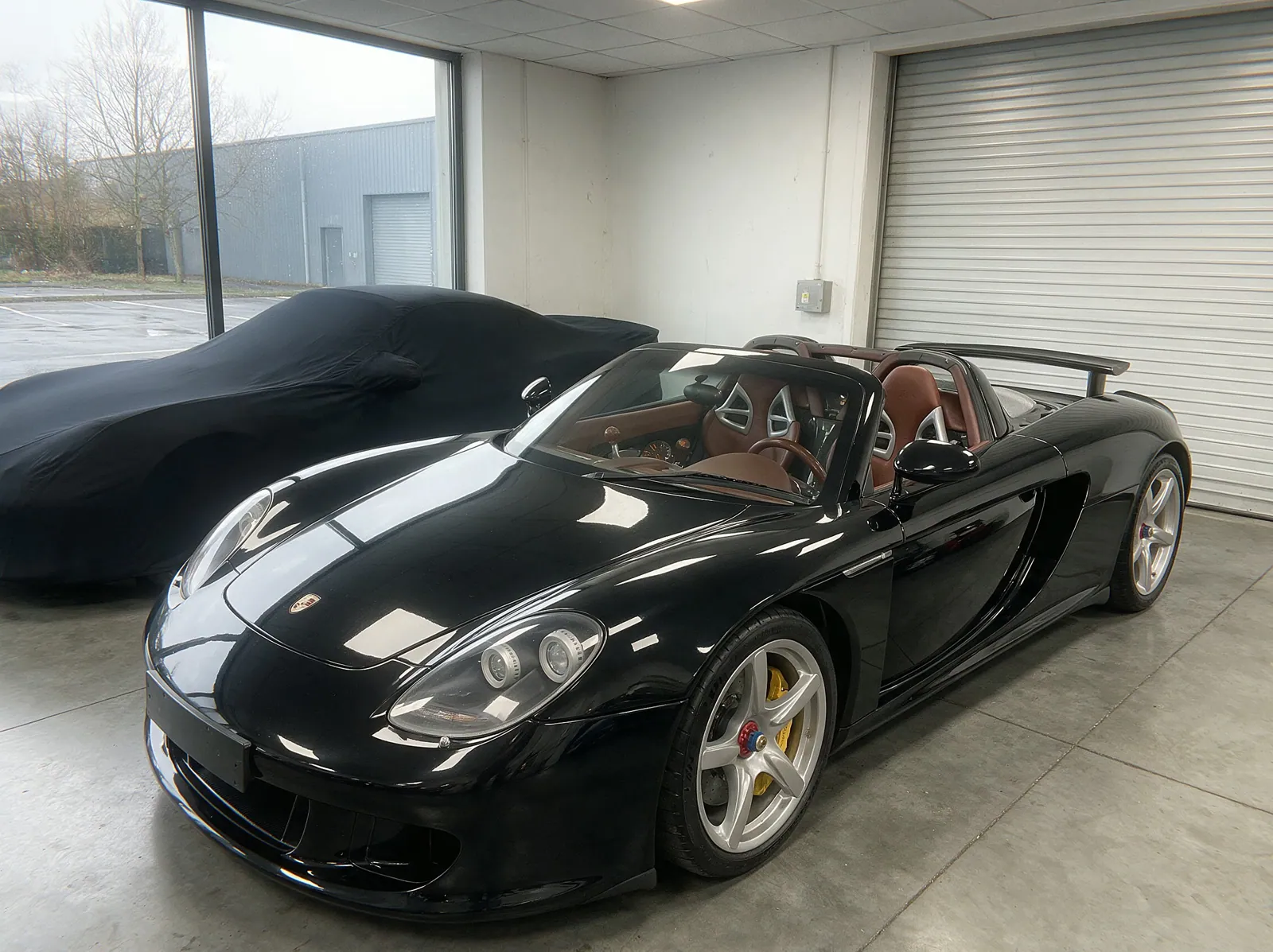
- Full service history
- 603hppower
- ≈14 000kmmileage
- 2006first registration
Photos
12 photosWhy this car is special
ModelA V10 built for Le MansThe Carrera GT's engine comes from a racing prototype that never started a race.
Porsche developed the LMP 2000, internally called 9R3, in the late 1990s to win Le Mans again. Its water-cooled V10 displaced 5.5 litres, weighed 165 kg and was designed to rev to 8,900 rpm.
When Porsche stopped the programme in 1999 to concentrate on new production models, the engine found a second career. The Carrera GT concept, driven by Walter Röhrl through Paris on 28 September 2000, previewed it.
For production the V10 grew to 5.7 litres, with a 68° cylinder angle and 12.0:1 compression, delivering 450 kW (612 PS) at 8,000 rpm and 590 Nm at 5,750 rpm.
ModelThe first production Porsche built in carbonBoth the monocoque and the engine mount of the Carrera GT are carbon-fibre reinforced plastic.
It was the first time in a standard-production Porsche that the monocoque chassis and the engine mount were made entirely of carbon-fibre reinforced plastic. Porsche set up its own manufacturing facility for them at the new Leipzig factory in 2003.
Moulded Kevlar seat shells, ceramic brake discs and double-wishbone pushrod suspension completed the racing specification. The forged magnesium wheels use centre-lock bolts colour-coded by side of the car, to prevent fitting on the wrong side.
The result was a kerb weight of 1,380 kg, or 2.25 kg per PS. Porsche built 1,270 cars between autumn 2003 and May 2006.
ModelThe world's first ceramic clutchTo mount the V10 as low as possible, Porsche needed a clutch smaller than any before it.
The Carrera GT introduced the world's first ceramic two-plate dry clutch, the Porsche Ceramic Composite Clutch (PCCC). Its plates measure just 169 mm in diameter.
The compact clutch allowed a very low centre of gravity for the V10 and the six-speed manual gearbox, which is mounted transversely, a layout taken directly from motorsport.
On top sits a tall gear knob of laminated beech wood, a nod to the early days of motorsport. Porsche quotes 3.9 seconds to 100 km/h and 9.9 seconds to 200 km/h.
ModelGround effect hidden under the carThe Carrera GT makes its downforce out of sight.
Porsche wanted the production car to keep the shape of the concept unchanged, so the downforce needed for 330 km/h had to come from elsewhere. The only visible aerodynamic device is an electrically extending rear wing.
The entire carbon underbody is panelled and, together with the rear diffuser, creates a ground effect like that of a racing car.
The roof is a true targa: its two halves are removed by hand and stowed in the front luggage compartment.
This carNumbered Carrera GT plaqueAn engraved number on brushed aluminium, placing this car within a run of 1,270.
Porsche built 1,270 Carrera GTs, and each carries its own number on a plaque in the centre console. The surrounding aluminium is brushed rather than polished, in keeping with a car conceived around a racing engine and a carbon-fibre chassis.
The plaque sits just below the traction control switches, within easy sight of the driver. It is the detail that turns a model into one particular car, read at a glance every time you take the wheel.
This carManual gearbox with ball-shaped gear knobSix gears, a clutch pedal and a round knob trimmed in brown leather.
The Carrera GT was offered only with a six-speed manual gearbox, paired with a compact ceramic clutch developed for the car. The ball-shaped knob recalls the shifters of Porsche's racing cars, and the shift pattern is engraved beside it.
On this car the knob and lever are finished in leather, as the factory list records, in a brown that matches the Ascot Brown interior. Every change is a deliberate, mechanical act, and the car asks for full attention in return.
This carCarbon bucket seatsCarbon shells on silver frames, with bolsters in Ascot Brown leather.
The Carrera GT's seats are built as thin composite shells, light and rigid, in the same spirit as the carbon-fibre chassis they are mounted to. Left exposed at the back, the weave shows exactly how each seat is made.
This car's bolsters were specified in Ascot Brown leather, an option recorded in the factory list along with brown leather on the roll-bar trim, door armrests and side airbag covers. Against black paint, the interior gives the car a warmer, more personal character.
This carCentre-lock nut and yellow calipersOne coloured nut per wheel, and yellow calipers that mark the ceramic brakes.
Like a racing car, the Carrera GT secures each wheel with a single central nut. The nuts are colour-coded, red on one side of the car and blue on the other, because their threads turn in opposite directions. The yellow calipers belong to Porsche's ceramic composite brakes.
Behind the five-spoke wheel the yellow reads clearly against the silver, a combination that identifies the car's specification at a glance. For the driver, it is a reminder that the car was engineered from the circuit outward.
Car passport
Options from the factory list as given in the original listing. Codes as provided there.
Exterior 1
GCBWheels painted in body colour
Interior 9
577Luggage set in Ascot BrownGAFDashboard trim with decorative stitchingGAHLeather gear leverGARCentre console with decorative stitchingGASThicker leather armrest with decorative stitchingGAVLeather seat belt reel covers, decorative stitchingGBRIndividual floor matsGBTThicker leather steering wheel, decorative stitchingGCAContrast-colour three-spoke leather steering wheel with stitching
Technology and comfort 1
25291Chassis raised 10 mm at the factory
Specifications
This car
- First registration
- 01/2006
- Mileage
- ≈ 14,000 km
- Power
- 603 hp (450 kW)
- Fuel
- Petrol
- Gearbox
- Manual
- Exterior colour
- Black
- Interior
- Full leather
- Service history
- Full, according to the seller
- Location
- Netherlands
Model
- Engine
- V10, 5,733 cm³, naturally aspirated, 68° cylinder angle
- Power
- 450 kW (612 PS) at 8,000 rpm
- Torque
- 590 Nm at 5,750 rpm
- Gearbox
- 6-speed manual with ceramic clutch
- Drive
- Mid-engine, rear-wheel drive
- 0–100 km/h
- 3.9 s
- Top speed
- 330 km/h
- Weight
- 1,380 kg kerb
- Production
- 1,270 units, 2003–2006
Price and next step
Request this car
Leave your e-mail and we will get back to you about this car.